Bates numbering: every page, a unique name
Legal discovery produces mountains of pages from dozens of documents, and then lawyers must talk about them precisely: “page 142” is useless when forty documents each have one. The century-old answer is the Bates number: a unique, sequential identifier stamped on every page of a production — a prefix naming the set, plus a zero-padded sequence: ACME-000142. Once stamped, that page can be cited in depositions, filings and correspondence with zero ambiguity, forever. Bates Numbering stamps the series in one pass: you set the prefix, the start number, the padding (4, 6 or 8 digits, or none) and the position and size; numbering continues across the whole document. This article explains the convention's logic — why the padding matters, why the prefix is a namespace — for anyone meeting it for the first time.
 By the PDFJadoo Team5 min read
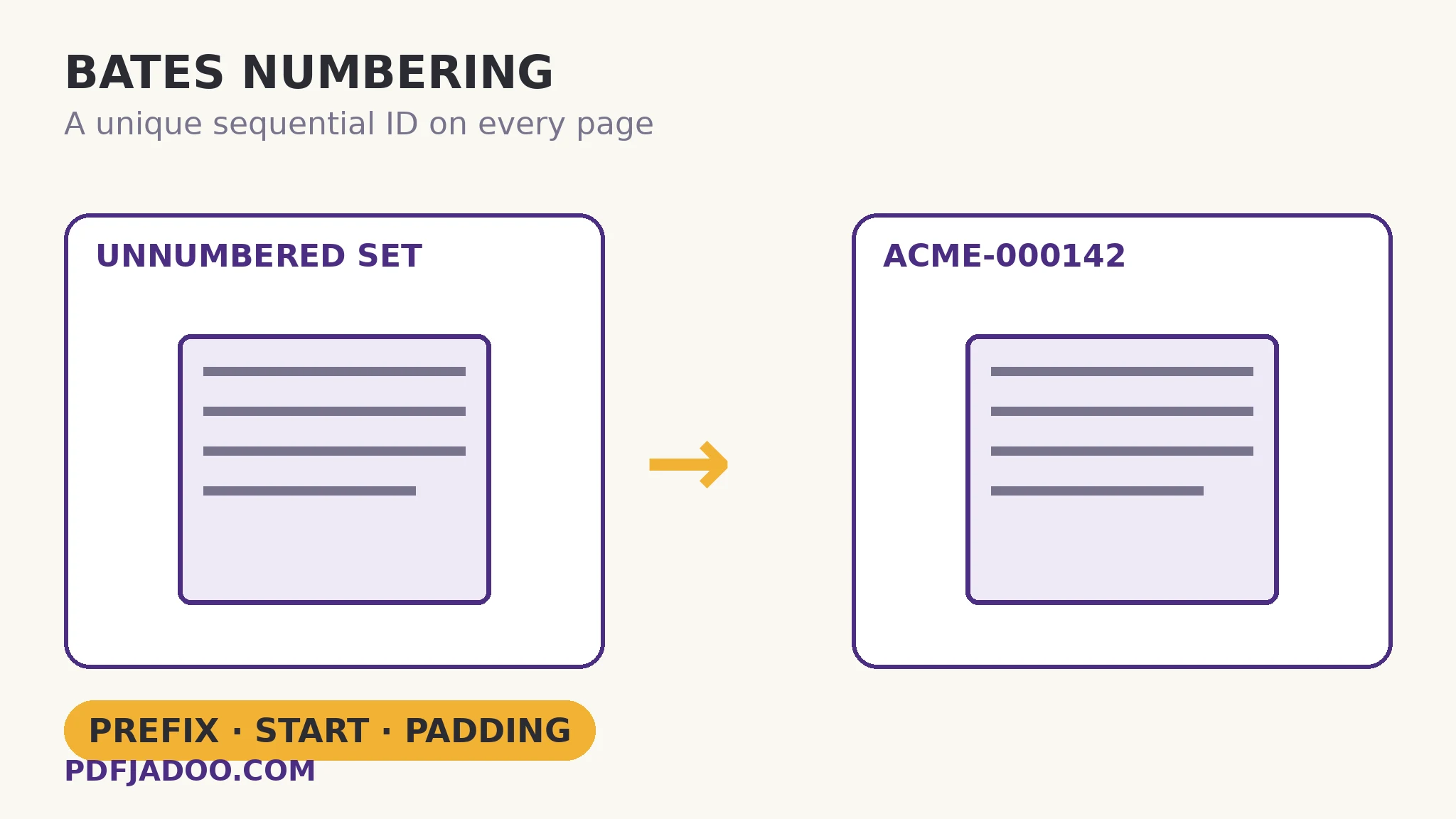
The format, piece by piece
The prefix is the namespace: typically a party or matter code (ACME, SMITH, DEF) that separates this production's pages from every other production's. Within a case, prefixes are allocated so two sets can never collide. The sequence is a simple count, starting where you set it — 1 for a fresh production, or continuing from the last production's end (start numbers exist precisely so a second tranche continues the series rather than restarting it). The padding — leading zeros to a fixed width — is the detail novices underrate: padded numbers sort as text. ACME-000042 files before ACME-000142 in any alphabetical listing; unpadded, “ACME-142” sorts before “ACME-42” and the production's order scrambles in every folder it touches. Padding width is chosen for the production's size: 6 digits covers a million pages; 4 suits a small set; 8 is the belt-and-braces of a mega-case.
The stamp itself follows the legal convention the tool names: drawn in a contrasting, box-free style at the page edge — visible, legible, and outside the page's content so it never competes with the evidence it labels. Position (bottom-right is the classic; four corners offered) and size (8–12 pt) are set once for the run. And the series is a series: numbering continues across the whole document in one pass, so a document's pages form an unbroken run of the production's names.
Why not just page numbers?
Ordinary page numbers identify a page within its document. Bates numbers identify a page within the universe of the case. The difference is the difference between “the third page of the contract” and “ACME-000142” — the second can be written in a filing, spoken in a deposition, and found in any copy of the production by anyone, instantly. Discovery's scale is what makes the stronger instrument necessary; anyone producing documents for litigation, investigation or audit inherits the need.
Stamp Bates numbers, step by step
Step 1 — settle the series before touching the tool. The prefix allocated to this production; the start number (1, or the continuation point); the padding width sized to the production. These are case decisions, recorded in the production log.
Step 2 — drop the PDF onto Bates Numbering. In your browser — discovery material does not visit servers.
Step 3 — set prefix, start, padding, position, size. Bottom-right, 10 pt is the convention's centre of gravity.
Step 4 — press Stamp the numbers and verify the run. First page, a middle page, last page: the sequence unbroken, the format exactly as logged.
Step 5 — record the range. The production log gains a line: this document = ACME-000101 to ACME-000142. The next document starts at 143 — which is why the start-number field exists.
Multi-document productions
Stamp document by document, continuing the start number from the log, and the production's pages form one continuous namespace across files. The discipline is clerical, not technical — which is to say, it is exactly the discipline that fails at 11 pm before a deadline. The log is the tool behind the tool.
Name every page like it will be cited. It will be.
Prefix, start number and padding set once — the whole document stamped in one continuous series.
Open Bates NumberingSources
- Cornell Legal Information Institute — Federal Rule of Civil Procedure 26: The discovery rule Bates numbering serves: parties must be able to identify every produced page, which is why each page carries a unique, sequential ID.
- Tool behaviour — the steps and limits in this guide are from PDFJadoo's own Bates Numbering tool page, checked 18 November 2026; the file never leaves your device, so the result you preview is the file you save.
A worked example: the second tranche
A production's first tranche ended at DEF-001180. The second tranche — fourteen documents, 640 pages — must continue the series, not restart it: restart would create a second DEF-000001, and the namespace would be broken for the life of the case. The stamper sets start = 1181 once, then works the documents in order, logging each range: Doc A DEF-001181–001260, Doc B DEF-001261–001388… The fourteenth document closes at DEF-001820. In the deposition three months later, “DEF-001455” is spoken once and every person in the room turns to the same page. That is the entire return on a clerical discipline — purchased with one field, set correctly, fourteen times.
Edge cases
Re-stamping a stamped document. Two series on one page is a production error that confuses everyone downstream. Bates-stamp final copies only, from unstamped masters.
Padding too narrow. A 4-digit series that reaches 10,000 pages rolls into 5 digits mid-production and the sort order breaks at the seam. Size the padding for the whole matter, generously.
Privileged pages in the run. Withheld pages are a production-log decision (numbers reserved, pages not produced) — the stamp follows the log, not the other way round.
Before you finish: the 60-second check
- Prefix, start number and padding were settled as case decisions — and logged
- Padding is wide enough for the whole production, not just this document
- First, middle and last pages verified: one unbroken series
- The stamped range was recorded; the next document continues from it
- Stamping was done on final copies, from unstamped masters
Fair questions
What is a Bates number?
A unique sequential identifier stamped on every page of a legal production: a prefix naming the set plus a zero-padded number — ACME-000142. It lets any page be cited unambiguously in filings and depositions, across all the documents in a case.
How do I add Bates numbering to a PDF?
Drop the PDF onto Bates Numbering, set the prefix, start number, padding (4, 6 or 8 digits, or none), position and size, and press Stamp the numbers. Numbering continues across the whole document in one pass.
Why pad the numbers with zeros?
So the series sorts correctly as text: ACME-000042 files before ACME-000142 alphabetically. Unpadded, “142” sorts before “42” and the production's order scrambles in file listings. Choose the width for the production's total size.
Can a series continue across several documents?
Yes — that is what the start-number field is for. Stamp each document starting where the last ended, and log each range (Doc A: 000101–000142). The production forms one continuous namespace.
How is Bates numbering different from page numbers?
Page numbers locate a page within its document. Bates numbers locate a page within the whole case — citable in a filing or deposition with zero ambiguity, in any copy of the production.
Is my document uploaded?
No — stamping runs in your browser. Discovery material never leaves your device.
Tool behaviour — prefix/start/padding settings, four positions, 8–12 pt sizes, contrasting box-free edge stamps, and continuous numbering across the document — is from PDFJadoo's own Bates Numbering page. Checked 18 November 2026.
Keep reading
Add page numbers to a PDF
The within-document cousin: Page X of Y for ordinary readers.
Sanitize a PDF before sharing
Before production: scrub the extras the other side should not receive.
Add a header and footer to every page
The other every-page stamp — titles and handling lines for non-legal sets.
Compare two PDF versions
Two productions of the same document? See which pages actually moved.