Italy visa photo specifications: the 35 × 40 mm size that catches everyone out
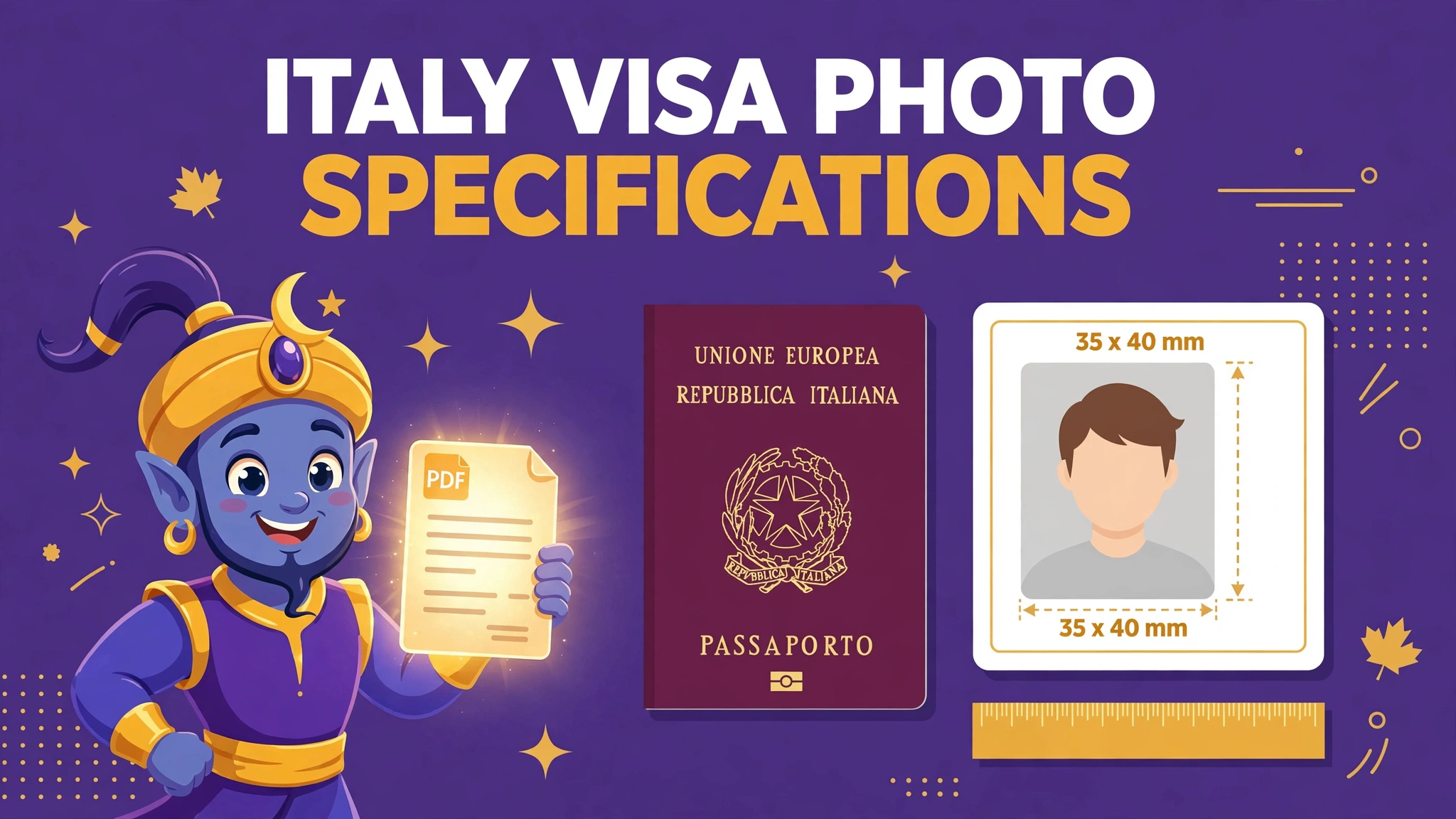
Most of Schengen uses a 35 × 45 mm photo. Many Italian consulates specify 35 × 40 mm instead — the same width, 5 mm shorter — on a white or light background, taken within the last six months, full face to camera. Submit the taller photo out of habit and the counter can refuse it before your application is even opened.
 By the PDFJadoo Team9 min read
The official rules, exactly as Italian offices publish them
Italy does not publish one single photo page for the whole world. The Ministry of Foreign Affairs and International Cooperation (MAECI) runs the Visto per l'Italia portal to tell you whether you need a visa and which office handles you, and the detailed photo specification then appears on that office's own pages — the consulate website on esteri.it, or the VFS Global checklist for your country. That structure matters, because the size is not identical at every office, and the honest version of this guide has to say so up front.
Across the consulate pages we checked, the recurring specification is 35 × 40 mm. The Consulate General in Toronto asks for one recent colour photo, taken less than six months before the application, size 35 mm × 40 mm, full-face against a light-coloured background. The Italian office in Taipei states the same 35 mm × 40 mm size in colour, with the face correctly centred and less than six months old. The consulate in Vancouver and the consulate in Ho Chi Minh City publish the same dimensions. The VFS Global tourism checklist for Italy phrases the width as a range — 35–40 mm in width — with a white background, and adds the ICAO conditions in full.
| Requirement | What the official pages specify |
|---|---|
| Photo size | 35 × 40 mm at many consulates (Toronto, Taipei, Vancouver, Ho Chi Minh City). VFS Global's Italy checklist gives a width of 35–40 mm. A minority of offices specify 35 × 45 mm — check yours. |
| Background | White on the VFS Global checklist; light-coloured on several consulate pages. Plain white satisfies both. |
| Recency | Taken less than six months before the application, and still a true likeness on the day you apply. |
| Face and pose | Full face, front view, face correctly centred, both sides of the face visible. No styled poses, no bowed or tilted head. |
| Head and expression (VFS/ICAO) | Head takes about two thirds of the photograph; look straight at the camera, neutral expression, mouth closed, eyes open and clearly visible. |
| Head coverings | Not permitted, except for religious reasons on the VFS checklist; several consulates state no hats, scarves or headbands at all. |
| Alteration | Digitally altered photos are forbidden — the VFS checklist says any alterations are strictly forbidden, and consulates mark the photo as not digitally altered. |
| Colour and quality | Colour photograph, professionally taken, printed on photo-quality paper where a print is handed in. |
Now the conflict, stated plainly because your application depends on it. The Consulate General in New York specifies 3.5 cm × 4.5 cm — that is, 35 × 45 mm — with a full front view and white background on its visa pages. So Italy is not one size everywhere: the majority pattern across the consulates we verified is 35 × 40 mm, at least one major office asks for 35 × 45 mm, and VFS Global's checklist expresses the width as a 35–40 mm range. The rule that never fails is this: the checklist of the office where you will actually submit is the specification that governs you. Read it before you print, not after you queue.
Why Italy photos get refused at the counter
Photo refusals are rarely about photography. They are about a traveller preparing a perfectly good photo for the wrong specification — usually the specification of the last Schengen country they visited. Work through the failure list below and you will see the pattern: every item is a mismatch between the photo in the envelope and the line on the checklist.
- Wrong height: a 35 × 45 mm photo submitted to a consulate that specifies 35 × 40 mm
- Stale photo: taken more than six months ago, however good it looks
- Coloured or patterned background instead of plain white or light
- Angled pose: head tilted, looking over a shoulder, face not centred, one side of the face hidden
- Headgear in frame: hats, scarves, headbands or decorative objects the consulate pages expressly exclude
- Glasses problems: tinted lenses, flash reflection across the eyes, frames covering part of the eyes
- Retouching: beauty filters, background-replacement apps and any digital alteration — expressly forbidden
- Head too small: on the VFS/ICAO wording, the head should take about two thirds of the photograph
The glasses point deserves care, because applicants assume they must either wear them or remove them. The Taipei consulate page threads it precisely: you are not required to wear your glasses in the photo, but if you do, your eyes must appear clearly — no tinted lenses, no flash reflections, and frames that do not cover any part of your eyes, with light or thin frames recommended. Removing glasses for the photograph is the simpler, safer choice, and no page we checked penalises you for it.
There is also a quieter trap for digital submissions and print shops alike: a photo cropped to 35 × 40 mm on screen but printed at the studio's default 35 × 45 mm, or the reverse. The specification is a physical measurement of the finished print. Measure the print itself with a ruler before you leave the studio — thirty seconds that have saved more appointments than any other step in this guide.
The fix, step by step, with the Passport Photo tool
Step one: confirm your size. Open the checklist or visa page of the consulate or VFS centre where you will submit, find the photo line, and write the dimensions down. If it says 35 × 40 mm, that is your target. If it says 35 × 45 mm — as New York does — that is your target instead. Do not average them and do not guess.
Step two: take the source photograph properly. Stand against a plain white wall in even, daylight-balanced light, camera at eye level, face straight to the lens, neutral expression, mouth closed, eyes open. Remove hats and headbands, take glasses off unless you have a reason to keep them, and have someone else take the picture — a selfie at arm's length distorts the face and rarely centres it. Take several frames; you need one excellent original, not a repaired one, because retouching is forbidden.
Step three: open PDFJadoo's Passport Photo tool and load your original. Crop to the exact frame your consulate specifies — 35 × 40 mm for most applicants following this guide — keeping the face centred, both sides visible, and the head filling roughly two thirds of the frame as the VFS/ICAO wording requires. The tool works on the geometry: size, centring and background. It does not beautify your face, and that restraint is deliberate — an altered photo is a refused photo.
Step four: export and verify. Save the finished file, then check it the way the counter will: dimensions correct, background plain, face centred, eyes clear, likeness current. If you are printing, print on photo-quality paper and measure the physical print with a ruler. A digital file that is right and a print that is wrong is still a wrong photo.
Step five: bring the photo as instructed. Several checklists say the photo is not to be affixed to the application form — the VFS Global checklist states this expressly — so carry it loose in the envelope unless your own office's instructions say to attach it. Small instruction, real consequences: counters have returned forms for less.
Make your Italy photo at the exact size — free
Crop your portrait to 35 × 40 mm (or the size your consulate lists), centred, on a plain background — in your browser, with nothing uploaded.
Make my Italy photoA worked example: the drawer full of Schengen photos
Consider a typical case. An applicant in Toronto is applying for a national study visa. In a drawer she has a set of crisp 35 × 45 mm photos from a French application last year — white background, professionally printed, well within six months at the time, now just over. The temptation is obvious: the photos look right, and France accepted them.
For Italy in Toronto, they fail twice. The Toronto consulate specifies 35 mm × 40 mm for the study visa photo, so the French photos are 5 mm too tall. And by the application date they are more than six months old, so they fail the recency rule independently. Either failure alone is enough; together they guarantee a wasted trip.
The fix took one sitting. She checked the Toronto page and wrote down 35 × 40 mm. She took a fresh portrait against a white wall, glasses off, face centred. She cropped it in the Passport Photo tool to 35 × 40 mm with the head filling about two thirds of the frame, printed it on photo paper, and measured the print: 35 mm across, 40 mm down. That measured print — not the handsome French set — is the one that belongs in the envelope. The lesson generalises to every Schengen application you will ever make: photos are not interchangeable between countries, even inside the same visa zone, and Italy is the country that proves it.
The 60-second check before you seal the envelope
Sixty seconds, six questions. One: does the print measure exactly what your consulate specifies — 35 × 40 mm for most, verified with a ruler, not by eye? Two: was it taken less than six months ago? Three: is the background plain white, with nothing and nobody else in frame? Four: is your face centred, front-on, both sides visible, eyes open and unobscured, mouth closed, expression neutral? Five: is your head bare of hats, scarves and headbands, and — if you kept glasses on — are your eyes completely clear of tint and reflection? Six: is the photo unaltered, with no filter or background edit of any kind?
If any answer is no, remake that element now, at home, where a remake costs minutes. At the counter it costs an appointment. Italy's photo rule is not difficult — it is simply different, by 5 mm, from the one your hands remember. Respect the difference and the photograph becomes the easiest document in your file.
Fair questions
What size is an Italy visa photo?
Many Italian consulates specify 35 × 40 mm — 35 mm wide and 40 mm high. That is 5 mm shorter than the 35 × 45 mm photo most Schengen countries use. A minority of Italian offices specify 35 × 45 mm instead, so confirm the size on your own consulate's checklist before you print.
Can I use my 35 × 45 mm Schengen photo for Italy?
Not safely. If your consulate specifies 35 × 40 mm, a 35 × 45 mm photo is the wrong height and can be refused at the counter. Prepare a photo in the exact size your consulate lists.
What background does Italy require?
A plain white background on VFS Global checklists for Italy, described as a light-coloured background on several consulate pages. Use plain white: it satisfies both wordings.
How recent must the photo be?
Less than six months old — the consulate pages put it as taken within the six months before you apply, and it must still resemble you on the day of application.
Can I wear glasses in an Italy visa photo?
You are not required to wear them. Consulate guidance says that if you do, your eyes must appear clearly, with no tinted lenses, no flash reflections and frames that do not cover any part of your eyes. The safest choice is to take the photo without glasses.
Is my photo uploaded to PDFJadoo when I size it?
No. PDFJadoo's photo tools run entirely in your browser, so the image stays on your device. Nothing is sent to or stored on a server.
Sources: Ministry of Foreign Affairs and International Cooperation (MAECI) — Consulate General of Italy in Toronto, National Study Visa page (35 mm × 40 mm, less than six months old, full-face, light-coloured background, no headgear); Italian office in Taipei, How to apply for a visa (35 mm × 40 mm, glasses conditions); VFS Global, Checklist for Tourism Schengen Visa for Italy (width 35–40 mm, white background, head two thirds of the photograph, alterations strictly forbidden). Conflict note: Italian offices do not all publish the same size — the Consulate General in New York specifies 35 × 45 mm on its visa pages, while Toronto, Taipei, Vancouver and Ho Chi Minh City specify 35 × 40 mm. Always follow the checklist of the office where you submit. This page is general information only and is not legal or immigration advice. PDFJadoo is not affiliated with the Ministry of Foreign Affairs and International Cooperation, any Italian consulate, or VFS Global.