France visa photo and documents: the face measurement that decides whether your photo passes
A French visa photo is an ICAO photograph — 35 × 45 mm, with your face measuring 32 to 36 mm from chin to forehead, hair excluded. That last clause is where French photos fail differently from everyone else’s. Here are the France-Visas rules, the fees and the timing windows, in one place.
 By the PDFJadoo Team9 min read
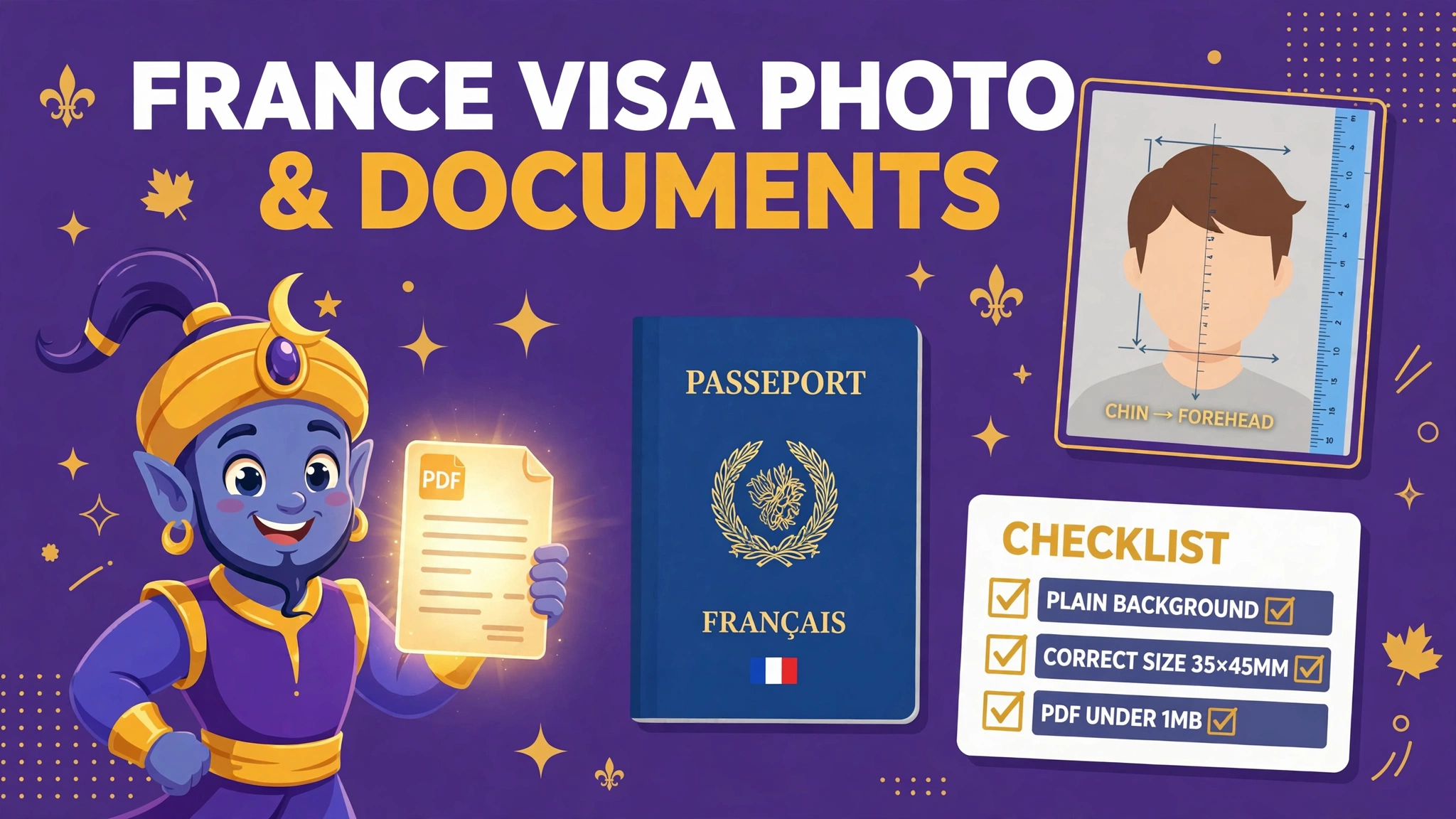
The photo rule, as France-Visas states it
France runs its visa information through France-Visas, the official portal, and its guidance follows the ICAO standard that most of Europe shares — with the measurement spelled out more precisely than most. The photograph must be recent, must resemble you, and must be framed so that your face — measured from the bottom of the chin to the top of the forehead, not counting hair — measures between 32 and 36 mm. On a 35 × 45 mm photograph, that is the familiar 70–80% band, but defined by landmarks rather than by the whole head.
| Requirement | What France-Visas specifies |
|---|---|
| Format | ICAO-standard photograph, 35 × 45 mm. |
| Face height | 32–36 mm, measured chin to forehead, excluding hair (70–80% of the picture). |
| Recency | Recent, and it must genuinely resemble the applicant. |
| Copies | Two ICAO-format photographs in the application file. |
| Fees | €90 for a short-stay visa; €99 for a long-stay visa. |
| When to apply | At least 2 weeks before travel; no earlier than 6 months ahead. |
| Biometrics | Fingerprints can be reused for 59 months from a previous Schengen application. |
| Coverage | One visa, 29 Schengen states. |
The chin-to-forehead definition matters in practice. A tall hairstyle, a fringe, or a head covering worn high can push a whole-head measurement into the band while the actual face — the part France measures — falls short of 32 mm. Conversely, applicants who crop tightly to make the "head" fill 80% often cut the forehead measurement past 36 mm. When you frame the photo, measure the face itself: chin at the bottom, forehead at the top, hair ignored.
Documents, timing and the biometrics shortcut
The photo travels with two copies in the file — two identical ICAO photographs, not one print and a photocopy. Around it, the France-Visas process rewards applicants who respect its two timing windows. Apply too late and even a perfect file cannot save the trip: the official guidance is to lodge the application at least two weeks before departure. Apply too early and it is equally invalid — no more than six months ahead. Between those rails, the fee is €90 for short stay and €99 for long stay, paid as part of the process.
The quiet advantage in the French system is biometric reuse. If your fingerprints were collected for a Schengen visa within the last 59 months, they can generally be reused, which can spare you a fresh biometrics appointment depending on your case. It is worth stating your previous visa’s dates accurately rather than assuming either way — the reuse is a property of the shared Schengen system, and the file decides it, not the applicant.
For the documents themselves, prepare the way every modern portal rewards: a generated checklist worked through item by item, each document scanned complete and legible, multi-page evidence merged in page order, and anything overweight compressed once rather than repeatedly. PDFJadoo’s Document Checklist Generator builds the list, Merge PDF assembles the files, and Compress PDF handles the weight — in your browser, where passport scans belong.
- Face 32–36 mm chin to forehead, hair excluded — measure the face, not the head
- Two identical ICAO photographs in the file
- Apply between 6 months and 2 weeks before travel
- €90 short-stay / €99 long-stay fee, ready when the process asks
- Previous Schengen fingerprints (within 59 months) noted accurately for reuse
The photo can be prepared with PDFJadoo’s Passport Photo tool on the Schengen visa preset — the same 35 × 45 mm ICAO frame with the 70–80% face band — which is the correct starting point for France. Use the tool’s framing guides to place chin and forehead, not hair, inside the band, and start from an honest, unretouched photograph: ICAO compliance is about measurement and likeness, and an edited face fails the second while passing the first.
How French photos fail — and the pre-flight check
The failure pattern is distinctive. First, the hair problem: an applicant with voluminous hair measures crown-to-chin, lands "inside" 70–80%, and is refused because the face itself is 29 mm. Second, the tight crop: an applicant zooms in to be safe and pushes the face past 36 mm. Third, the single copy: one beautiful photo, where the file wants two identical ones. Fourth, the stale photo: a portrait from three summers ago that no longer resembles the person at the desk — the rule says recent and resembling, and either half can fail alone.
So run the check the French way before you submit. Print or open the photo at true size and measure with a ruler: chin to forehead, 32 to 36 mm, on a photo 35 mm wide and 45 mm tall. Confirm you hold two identical copies. Confirm the face in the photo is the face in your mirror this month. Confirm your application date sits inside the window — not inside two weeks, not beyond six months. Four small confirmations, and the most commonly refused item in the French file becomes the least interesting thing in it. C’est tout — the rest is paperwork.
Where the photo goes: the France-Visas journey in brief
Understanding where the photograph is judged helps you prepare it properly. A French application begins on France-Visas itself: you create an account, complete the application form online, and the system tells you which documents your situation requires and where to lodge them. In most countries the file is then submitted in person at a visa application centre or consulate, where your biometrics are taken (unless the 59-month reuse applies) and your two photographs are handed over with the paper file. The photo is therefore judged twice in two different ways: once by the checklist discipline of the centre that receives it, and once by the officer who compares it, later, with the person in front of them.
That double judgement explains the rule set’s shape. The measurement rules — 35 × 45 mm, face 32–36 mm chin to forehead — exist for the first judgement: they let a receiving clerk verify compliance in seconds, with a template, without discretion. The resemblance and recency rules exist for the second: an officer, weeks later, matching paper to person. A photograph can pass the template and fail the officer, or charm the officer and fail the template. Preparing for both is not pedantry; it is simply what the process, read carefully, asks.
One last practical habit: lodge the application with photographs you could reproduce. Keep the digital original of the exact image you submitted, untouched, until the visa is decided. If a centre asks for a replacement photo late in the process — a damaged print, a measurement dispute — the same image reprinted at the same size answers in a day. A different, newer photograph invites a fresh round of questions about why the file’s face changed mid-application.
Measure your French visa photo properly — free
The Passport Photo tool’s Schengen preset frames your honest photo at 35 × 45 mm with the 70–80% face band, in your browser. Place chin and forehead — not hair — inside the band.
Size my photo (Schengen) Build my checklistFair questions
What size is a France visa photo?
35 × 45 mm in ICAO format, with the face measuring 32–36 mm from chin to forehead — excluding hair — which is 70–80% of the picture. The file includes two identical ICAO photographs.
Why do French visa photos fail when other Schengen photos pass?
Usually the measurement: France defines the face as chin to forehead without hair. A photo measured crown-to-chin can look compliant while the actual face falls below 32 mm — or a tight crop pushes it past 36 mm.
How much is a French visa?
The fee is €90 for a short-stay visa and €99 for a long-stay visa, per France-Visas.
When should I apply for a France visa?
At least 2 weeks before you travel, and no earlier than 6 months ahead. Outside that window the application itself is mistimed, whatever its contents.
Can my old Schengen fingerprints be reused for France?
Generally yes — biometrics collected for a Schengen application within the last 59 months can be reused. State your previous visa dates accurately and let the file decide.
Is my photo uploaded to PDFJadoo when I size it?
No. PDFJadoo’s photo tools run entirely in your browser, so the image stays on your device. Nothing is sent to or stored on a server.
Sources: France-Visas (Ministry for Europe and Foreign Affairs) — France-Visas FAQ and the France-Visas application guidance (ICAO photograph; face 32–36 mm chin to forehead excluding hair, 70–80% of the picture; two photographs; fees €90 short-stay and €99 long-stay; apply at least 2 weeks and at most 6 months ahead; biometrics reusable for 59 months; 29 Schengen states). This page is general information only and is not legal or immigration advice. PDFJadoo is not affiliated with France-Visas.
Keep reading
Passport Photo
The Schengen preset: 35 × 45 mm, face in the 70–80% band.
Germany visa documents
The portal that checks your file before your appointment.
Document Checklist Generator
Build the list first; scan against it second.
Schengen documents via VFS
The scanning and preparation checklist for VFS routes.