Germany biometric photo rules: 35 × 45 mm, a strict face band — and no more paper photos
Germany’s biometric photo is defined by the official Foto-Mustertafel: 35 × 45 mm, with the face taking up 70–80% of the height (32–36 mm), on a light background, with a neutral expression. Since 1 May 2025, a paper print no longer gets that photo into a passport or ID card inside Germany at all — it must arrive digitally. This guide covers both halves: the measurements, and the new delivery rule.
 By the PDFJadoo Team9 min read
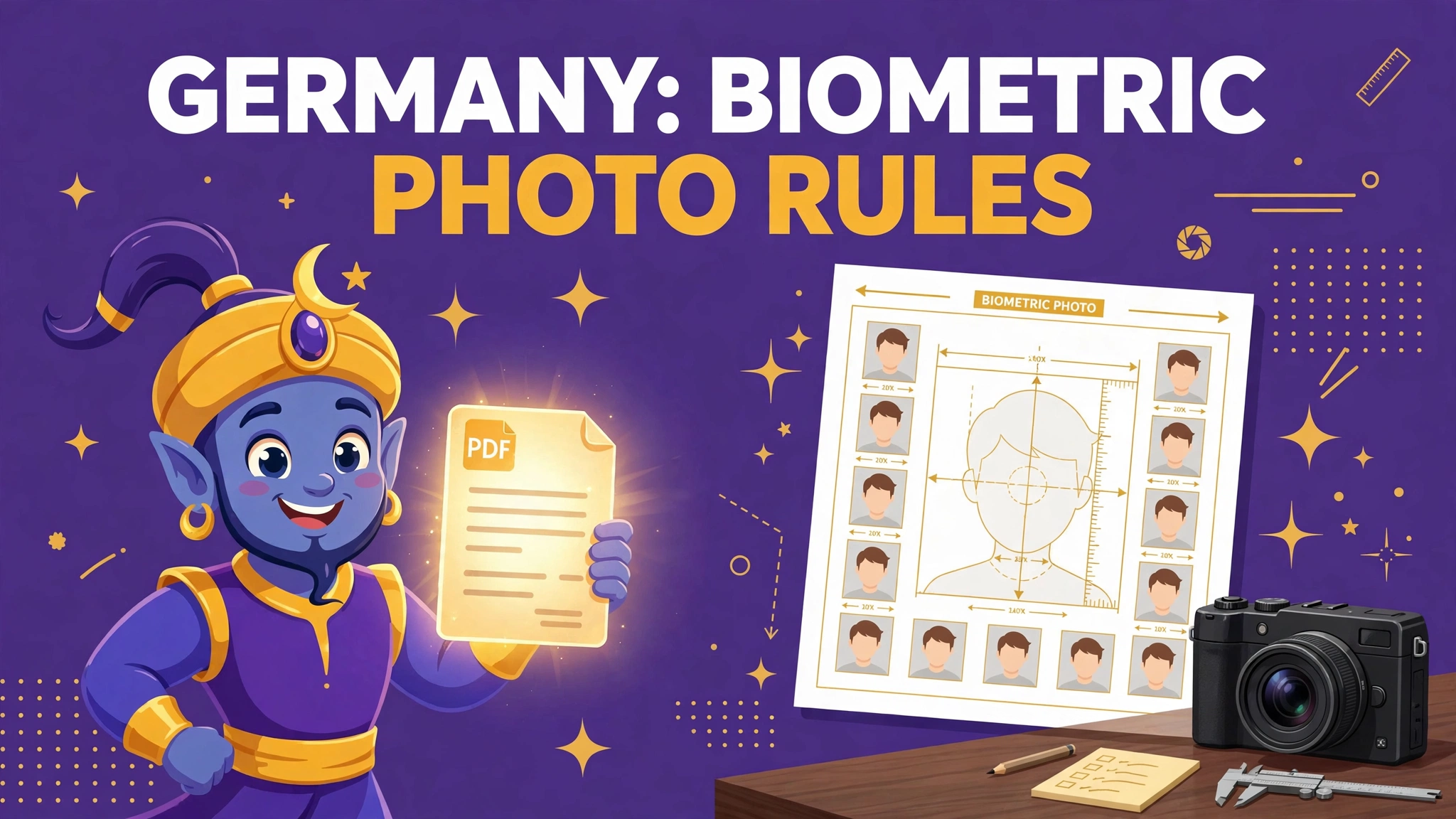
The official rules: the Foto-Mustertafel, in one table
Every German passport, identity card (Personalausweis) and electronic residence permit carries a biometric photo, and the standard for that photo is published by the Federal Ministry of the Interior (BMI) as the Foto-Mustertafel — the photo sample board produced with the Bundesdruckerei, Germany’s federal printing office. The BMI’s ID-card portal, Personalausweisportal, puts it plainly: you need a biometric passport photo, and the requirements are set out in that Foto-Mustertafel, with photo templates (Lichtbild-Schablonen) for adults and for children. The current edition of the board is dated October 2024.
The board is a measuring instrument, not a suggestion. It defines the frame, the size of your face inside that frame, and the hard limits beyond which a photo must be refused — because the top of the head is often hard to pinpoint, the board gives an ideal band and wider tolerance limits. Learn both numbers: aim for the ideal, and know where refusal actually begins.
| Requirement | What the official sources specify |
|---|---|
| Photo size | 35 mm wide × 45 mm high, portrait, no border. |
| Face height (adults) | 70–80% of the photo height — 32–36 mm from the tip of the chin to the top of the head. |
| Hard refusal limits | A photo is rejected if the face height falls below 27 mm or exceeds 40 mm. |
| Face height (children) | 50–80% of the photo height — 22–36 mm; rejected only below 17 mm or above 40 mm. |
| Pose and expression | Frontal view, head centred and straight, looking directly into the camera, neutral expression, mouth closed, both eyes open and fully visible. |
| Background | Uniform and light, contrasting with face and hair, with no patterns, no objects and no shadows. |
| Light and face | Even lighting, no shadows on the face, sharp focus, natural skin tones, no red-eye effect. |
| Glasses and coverings | Eyes must not be covered by hair or spectacle frames; dark or reflective lenses fail. Head coverings are accepted only for religious reasons, and the face must remain fully visible. |
| Recency | Current. German missions’ checklists require biometric photos not older than 6 months. |
| Delivery (in Germany) | Digital only since 1 May 2025 — taken at the authority or transmitted by a certified photographer via a secure electronic channel. Paper photos are no longer permitted. |
Two details catch people out. First, face height is measured from the tip of the chin to the top of the head — the crown, not the top of a tall hairstyle. Second, the background must contrast with your hair: a very light background behind very light hair can fail even when the photograph looks clean to you, because the biometric software needs a clear outline of the head.
The May 2025 change: paper photos ended inside Germany
Until 30 April 2025 you could walk into a Bürgeramt with a printed photo from a studio, a booth or your own printer, and hand it over. That route is closed. Berlin’s official service portal states the new rule in the same words across its residence-document pages: since 1 May 2025, biometric passport photos may only be taken digitally at government offices or photo studios and transmitted via a secure electronic channel. The BMI’s passport FAQ prices the on-site option: a digital photo taken at the authority on the Bundesdruckerei’s PointID system costs 6 euros extra.
In practice you now have exactly two routes inside Germany. Route one: have the photo taken at the authority during your appointment, on its capture terminal, for the 6-euro fee where PointID is used. Route two: go beforehand to a certified photographer or photo service, which takes the photo and transmits it securely to the authority; you receive a code — typically a data-matrix or QR printout — and the office retrieves your photo with that code when you apply. What you cannot do is take the photo yourself and bring it in any form: not printed, not on a USB stick, not as a file on your phone. The change exists to stop manipulated images — including morphed faces blended from two people — entering identity documents, and a self-supplied file defeats that purpose by design.
One exception matters to readers abroad: the digital-only rule governs applications inside Germany. German missions abroad that cannot yet capture or receive photos electronically may still accept a conventional printed 35 × 45 mm photo — German service portals note expressly that different rules can apply abroad and a paper photo may still be accepted there. Visa applications are a separate track again: missions’ checklists for national and Schengen visas still ask for printed biometric photos meeting the same Foto-Mustertafel measurements. So the measurements in the table above remain worth learning even though the Bürgeramt no longer takes your print.
Why photos get rejected
Rejection reasons split into two families: the photograph itself fails the template, or the photograph never legally reaches the desk. Both waste an appointment, and appointments are the scarce resource in German administration.
- Face too small or too large — outside the 32–36 mm ideal band, and refused outright below 27 mm or above 40 mm
- Head tilted, turned or off-centre, or eyes not looking straight into the camera
- Smiling with an open mouth, eyes half-closed, or hair falling across the eyes
- Patterned, dark or shadowed background — or a background that does not contrast with light hair
- Shadows across the face, harsh flash, red eyes, or a soft, out-of-focus image
- Dark or reflective spectacle lenses, or frames cutting across the eyes
- A paper photo brought to an appointment in Germany after 1 May 2025 — refused whatever its quality
- A selfie or home photo offered as the official image — there is no route for it into the system
- An old photograph: missions ask for photos not older than 6 months, and the image must show your current appearance
Notice what the certified routes protect you from: the photographer’s software and the office terminal both check the template at capture, so a framing failure is corrected on the spot rather than discovered weeks later. The failures that remain yours are appearance failures — a new haircut, glasses you forgot to remove, a head covering arranged so it shadows the face. Those you can rehearse.
The fix, step by step: what you can still prepare yourself
Be clear about the division of labour. The official photograph for a German passport, ID card or residence permit issued in Germany must be captured through the certified routes above — no website, including this one, can supply it. What you can do yourself is arrive rehearsed: know what a passing photo looks like, check your own practice portrait against the template, and prepare compliant photos for the applications that still take a file or a print, such as many visa applications at missions abroad. PDFJadoo’s Passport Photo tool is built for exactly that checking and preparation work, in your browser.
Step 1 — Take a clean practice portrait. Stand facing a plain, light wall in even daylight, camera at eye level, shoulders square. Neutral expression, mouth closed, eyes open, glasses off if you can manage without them for the photograph. Take several frames; pick the sharpest, most symmetrical one.
Step 2 — Open the Passport Photo tool and choose the 35 × 45 mm frame. Load your portrait. The tool works locally in your browser — the image is not uploaded to a server — which matters for an identity photograph.
Step 3 — Set the face inside the band. Crop and scale so your face, chin tip to crown, fills 70–80% of the frame height. This is the single measurement that decides most biometric checks; a portrait that shows your whole upper body will fail it, however professional it looks.
Step 4 — Check the background and light honestly. The background in your practice photo should be uniform and light, with clear contrast against your hair, and your face free of shadow. If your kitchen wall fails that test, your rehearsal has just told you what to fix before the real capture: different wall, different light, hair off the face.
Step 5 — Export and keep the file. Save the finished 35 × 45 mm image. Use it where a file or print is genuinely accepted — a visa checklist that asks for printed biometric photos, an employer or university that needs an ID-style photo — and use it as your reference for how you should look on capture day.
Step 6 — Book the real capture. For the German document itself, either plan the extra minutes and the 6-euro fee for the terminal at your authority, or visit a certified photographer shortly before your appointment and keep the retrieval code safe. Bring the code, not a print.
Check your framing against the template — free
The Passport Photo tool frames your portrait at 35 × 45 mm and helps you place your face in the 70–80% band, entirely in your browser. It prepares and checks photos — the official image for a German document still comes from the authority’s terminal or a certified photographer.
Check my photo framingA worked example: the drawer full of old prints
Consider a typical case. An applicant in Munich needs a new Personalausweis. In a drawer are four studio prints from two years ago — correct size, good quality, taken for the previous card. Under the old system they would have been borderline (age alone made them risky); under the current system they are simply unusable, because no paper photo may be processed at all. The applicant’s real choices are the terminal at the Bürgeramt for 6 euros, or a certified photographer near the office who transmits the new photo and hands over a code.
Where rehearsal helped this applicant was different. At the terminal, the first capture failed the template: hair volume made the measured face height read too large, and a shadow fell across one cheek from the room’s side light. Because the applicant had already checked a practice portrait at home, the fixes were familiar — hair flattened and tucked, face turned square to the lens, a small step to centre in the light — and the second capture passed. The 35 × 45 mm measurements never stopped applying; only the messenger changed. Applicants who understand the template spend two minutes at the terminal. Applicants who do not can spend an appointment.
The 60-second check
Before any German photo appointment, run these six checks. One: route — are you applying inside Germany? Then plan on the authority’s terminal or a certified photographer, and leave paper prints at home. Two: code — if a photographer transmitted your photo, is the retrieval code in your appointment folder? Three: appearance — does your hair sit so your full face and both eyes are unobstructed? Four: glasses — can you remove them for the capture, or if not, are the lenses clear and the frames clear of your eyes? Five: expression — practise the neutral face: mouth closed, eyes open, shoulders square. Six: timing — if a mission abroad or a visa checklist is taking your print instead, is the photo less than 6 months old and truly 35 × 45 mm? A minute of checking against the template is the cheapest insurance in the whole application.
Fair questions
What size is a German biometric photo?
35 mm wide by 45 mm high, with no border. The face — measured from the tip of the chin to the top of the head — must take up 70 to 80 percent of the photo height, which is 32 to 36 mm.
Can I still bring a printed photo to a German citizens’ office?
No. Since 1 May 2025, photos for passports, ID cards and residence documents in Germany may only be taken digitally at the authority or by a photo studio and transmitted via a secure electronic channel. Paper photos are no longer permitted.
How much does the photo at the authority cost?
6 euros. The Federal Foreign Office’s passport guidance and Berlin’s service pages both list 6.00 euros for creating a digital passport photo at the self-service terminal on site, where the authority uses the Bundesdruckerei PointID system.
What background does the German photo need?
A uniform, light background that contrasts with your face and hair, with no patterns and no shadows. Your face must also be free of shadows, evenly lit, and shown frontally with a neutral expression and closed mouth.
Are the rules looser for children?
Yes. For children the face height must be 50 to 80 percent of the photo, which is 22 to 36 mm, and a child’s photo is only rejected below 17 mm or above 40 mm. The official portal also provides separate photo templates for children aged 6 to 9.
Can PDFJadoo make the official photo for my German passport?
No — and no online tool can. Inside Germany the official photo must come from the authority’s terminal or a certified photographer’s secure transmission. PDFJadoo’s Passport Photo tool helps you check framing, face height and background on a practice photo, and to prepare photos for uses that still accept a file or print, such as many visa applications abroad.
Sources: Federal Ministry of the Interior (BMI) — Foto-Mustertafel: quality features of biometric photos (edition 1, 10/24: 35 × 45 mm; face height 70–80%, 32–36 mm; rejection below 27 mm or above 40 mm; children 50–80%, 22–36 mm) and the BMI passport FAQ (digital photo at the authority via PointID, 6 euros); Personalausweisportal (a biometric photo is required; requirements in the Foto-Mustertafel; templates for ages 10+ and 6–9); Berlin’s official service portal, service.berlin.de — e.g. residence permit pages (“Since May 1, 2025, biometric passport photos may only be taken digitally at government offices or photo studios and transmitted via a secure electronic channel”; on-site photo 6.00 euros); German missions’ national-visa leaflets (photos not older than 6 months). Scope note: the digital-only rule applies to applications inside Germany; missions abroad that cannot capture photos electronically may still accept paper prints, and the official pages note that differing rules can apply abroad. This page is general information only and is not legal or immigration advice. PDFJadoo is not affiliated with the Federal Ministry of the Interior, the Bundesdruckerei or the Personalausweisportal.
Keep reading
Passport Photo
Frame and check a 35 × 45 mm portrait in your browser.
Berlin residence permit uploads
Formats, the 7 MB file limit and the 100 MB total, explained.
Why was my photo rejected?
The failure patterns behind biometric photo refusals.
France visa photo and documents
Another 35 × 45 mm system, with its own traps.