The cover letter: five parts — and one detail that is true
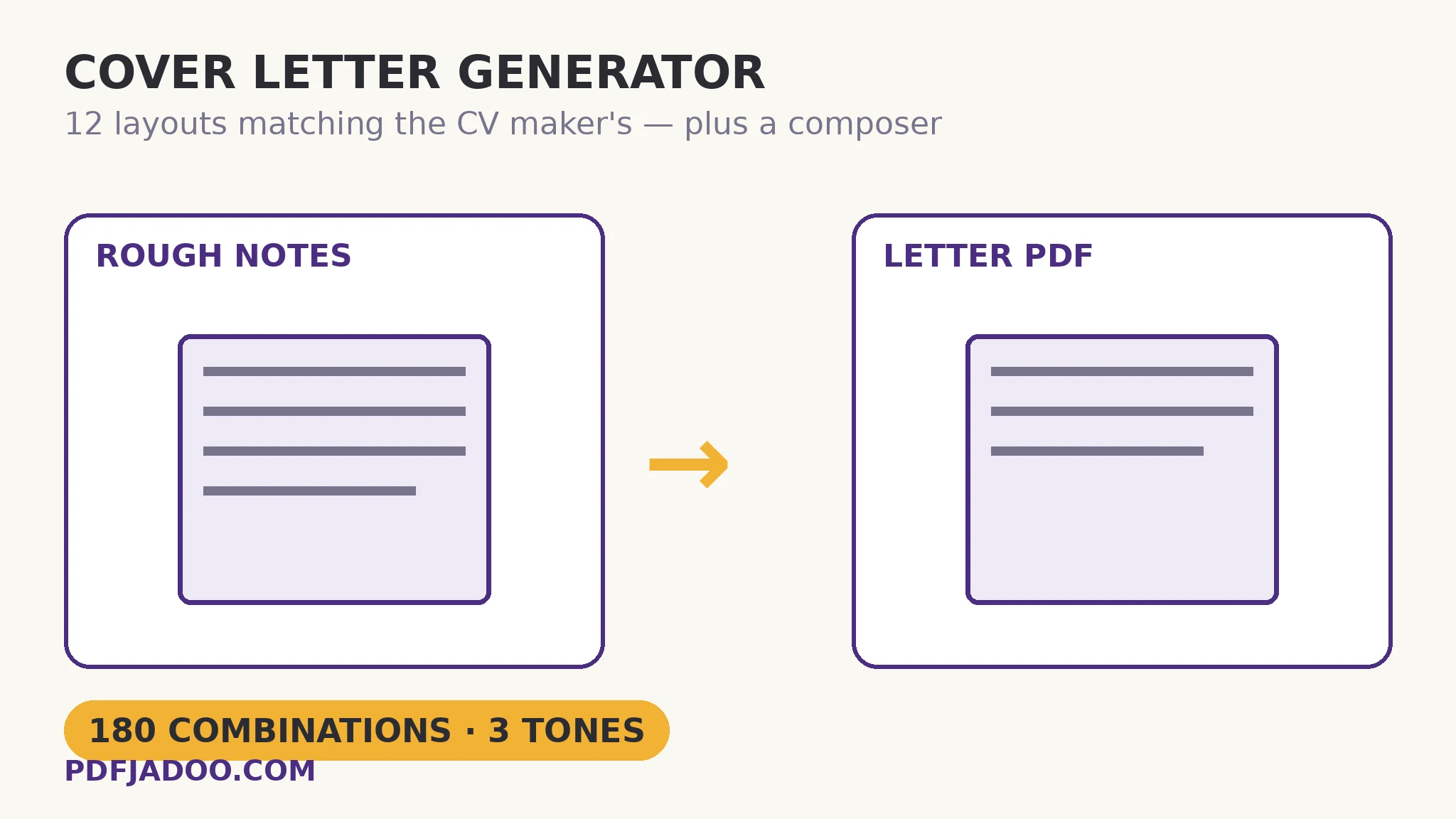
The direct answer: a working cover letter has five parts — header, greeting, opening, a proof body of one paragraph per point, and a closing with the right sign-off — fits one page, and can be styled to match your CV exactly: 12 letter layouts across the same five styles, × 5 colour themes × 3 font pairings = 180 combinations, the same family arithmetic as the CV builder's. Cover Letter Generator adds a genuinely considerate feature: a smart composer that drafts the letter from your rough notes — profession, years of experience, target role, target company, key skills, free notes in any order — entirely in your browser, in a tone you choose (Professional, Warm or Confident), leaving every word yours to edit before the PDF is created. The guidance printed with the tool is the craft in miniature: body paragraphs go one per line; the proven shape is why this role, what you bring, a specific proof, a warm close; sign-offs run Yours sincerely, Kind regards, Best regards or Warm regards — and the page's tip is the whole game: one specific, true detail about the company beats three generic compliments. This article walks the five parts and the discipline that keeps the letter at one page.
 By the PDFJadoo Team6 min read
The five parts, and what each is for
The direct answer: the header identifies (you, the role, the date); the greeting addresses a person where one can be found; the opening states why this role at this company; the body proves fit with specifics, one paragraph per point; the closing asks warmly for the conversation and signs off correctly. Each part is short because the letter's economics are brutal: one page is the discipline — a letter that needs a second page has usually repeated the CV, which the reader already has. The body is where letters are won: not “I am a hard-working team player” (unfalsifiable, unread) but the proof paragraph — the project, the number, the outcome — aimed at this company's stated need. One quotable allocation: of the letter's paragraphs, exactly one should be about the company specifically — the detail that could not be sent to any other employer — and it is worth more than the rest combined, because it is the only paragraph that proves the application is real.
Matching the CV is not vanity: the same layout family, colour theme and font pairing across both documents (the 180 combinations mirror the CV builder's system) makes the pair read as one considered application — the visual equivalent of a firm handshake. Recruiters notice coherence; its absence reads as assembly from strangers' templates.
The smart composer, honestly framed
The direct answer: the composer turns rough notes into a structured draft — it does not know your career, so its output is clay, not marble: you edit every word, replace its generalities with your specifics, and delete anything you could not defend in the interview it is trying to win. Its honest value is the blank-page cure and the structure: notes in any order become the five parts in the right order, in a chosen tone. A draft you must personalise is a tool; a letter you send unedited is a tell — hiring managers read composer-ese fluently, and the specific-detail rule is precisely the antidote.
Write the letter, step by step
The direct answer: feed the composer your notes or write directly, shape the body one paragraph per line in the proven order, choose the layout family that matches your CV, pick the sign-off, and download the one-page PDF.
Step 1 — notes or draft. Give the smart composer your profession, experience, target role and company, key skills and free notes — or start from a blank body. Choose the tone: Professional, Warm or Confident.
Step 2 — edit like it matters. Every word is yours to change. Insert the specific, true detail about this company; replace generic claims with your proof; cut anything you could not defend aloud.
Step 3 — body in the proven shape. One paragraph per line: why this role, what you bring, a specific proof, a warm close. Watch the page count — one page is the discipline.
Step 4 — match the CV. Same style family, colour theme and font pairing as your CV from the builder's system — the pair arrives as one application.
Step 5 — sign-off and download. Yours sincerely (the traditional pairing for a named greeting), Kind regards, Best regards or Warm regards. Preview, download, send with the CV it matches.
The greeting problem
The direct answer: a named greeting beats “Dear Sir/Madam” wherever the hiring manager is findable — the listing, the company's site, a call to reception — and five minutes of finding converts the letter's first line from a form into an address. Where no name exists, a role greeting (“Dear Hiring Manager”) keeps the dignity the generic salutation spends.
Five parts, one page, one true detail — matched to your CV.
A composer that drafts from your notes, 180 combinations to pair with your CV, and every word left yours to edit.
Open Cover Letter GeneratorA worked example: the career-changer's letter
The direct answer: a warehouse supervisor applying into logistics coordination drafts from notes — eight years, the target role, two key skills, a free note about the company's new regional hub — and the composer's Professional draft becomes, after editing, a letter whose opening names the hub, whose proof paragraph carries the supervisor's real numbers, and whose close asks for the conversation in one sentence. The walkthrough's edits are the lesson: three generic sentences deleted, one company-specific paragraph written from the applicant's own reading, every claim tied to something the interview could verify. Sent with the matching CV, the pair read as one person's considered application — which, after the editing, is exactly what they were.
Edge cases
Speculative applications. No listing means the opening carries more weight: the specific detail about the company becomes the reason the letter exists. The five parts hold; the proof aims at the team's plausible needs, honestly framed as such.
Internal applications. Shorten, do not skip: the reader knows your work but not your intent, and the letter is the intent document. Warmth is permitted; presumption is not.
When no letter is wanted. Some portals omit the letter entirely — obey the portal. Where an optional “additional information” box exists, the letter's opening and proof paragraphs compress into it gracefully.
Before you finish: the 60-second check
- Five parts present; body one paragraph per line in the proven order
- One paragraph is specific to this company — a detail sendable nowhere else
- Composer output fully edited: generalities replaced, indefensible claims deleted
- One page held; sign-off chosen deliberately (Yours sincerely / Kind regards / Best / Warm regards)
- Layout, colour and fonts match the CV it travels with
Fair questions
What are the five parts of a cover letter?
Header (you, the role, the date), greeting (a named person where findable), opening (why this role at this company), the proof body — one paragraph per point: what you bring, a specific proof — and a closing with a warm ask and the right sign-off.
What does the smart composer do?
It drafts the letter from your rough notes — profession, years of experience, target role, target company, key skills, free notes in any order — entirely in your browser, in a Professional, Warm or Confident tone. You edit every word before creating the PDF; the draft is a starting point, not a sendable letter.
Can the letter match my CV?
Yes — 12 letter layouts across the same five styles as the CV builder, × 5 colour themes × 3 font pairings = 180 combinations, so letter and CV can match exactly and arrive as one considered application.
What sign-off should I use?
Yours sincerely, Kind regards, Best regards or Warm regards — Yours sincerely traditionally pairs with a named greeting. Any of the four is professionally safe; pick one and keep the tone consistent with the letter.
How long should a cover letter be?
One page. A letter that needs a second page has usually repeated the CV — which the reader already has. One paragraph per point, in the order: why this role, what you bring, a specific proof, a warm close.
What is the single most valuable sentence in the letter?
The specific, true detail about this company — the one that could not be sent to any other employer. Per the tool page's own tip, it beats three generic compliments, because it proves the application is real.
Tool behaviour — the 12 layouts × 5 colour themes × 3 font pairings, the smart composer's inputs, in-browser drafting and tones, the one-paragraph-per-line body guidance and proven shape, the four sign-offs, and the specific-detail tip — is from PDFJadoo's own Cover Letter Generator page. Checked 18 November 2026.
Keep reading
An ATS-friendly CV from a builder
The letter's pair: 360 combinations, one parseable skeleton.
A document checklist you can tick off
The application pack, organised: CV, letter, evidence — ticked off.
Passport photo maker: how it works
For the CV's Photo templates: a compliant picture, made to spec.
Certificates for a whole class
The achievements your CV lists, recognised in designed documents.