The receipt: issued at the moment money changes hands — not before
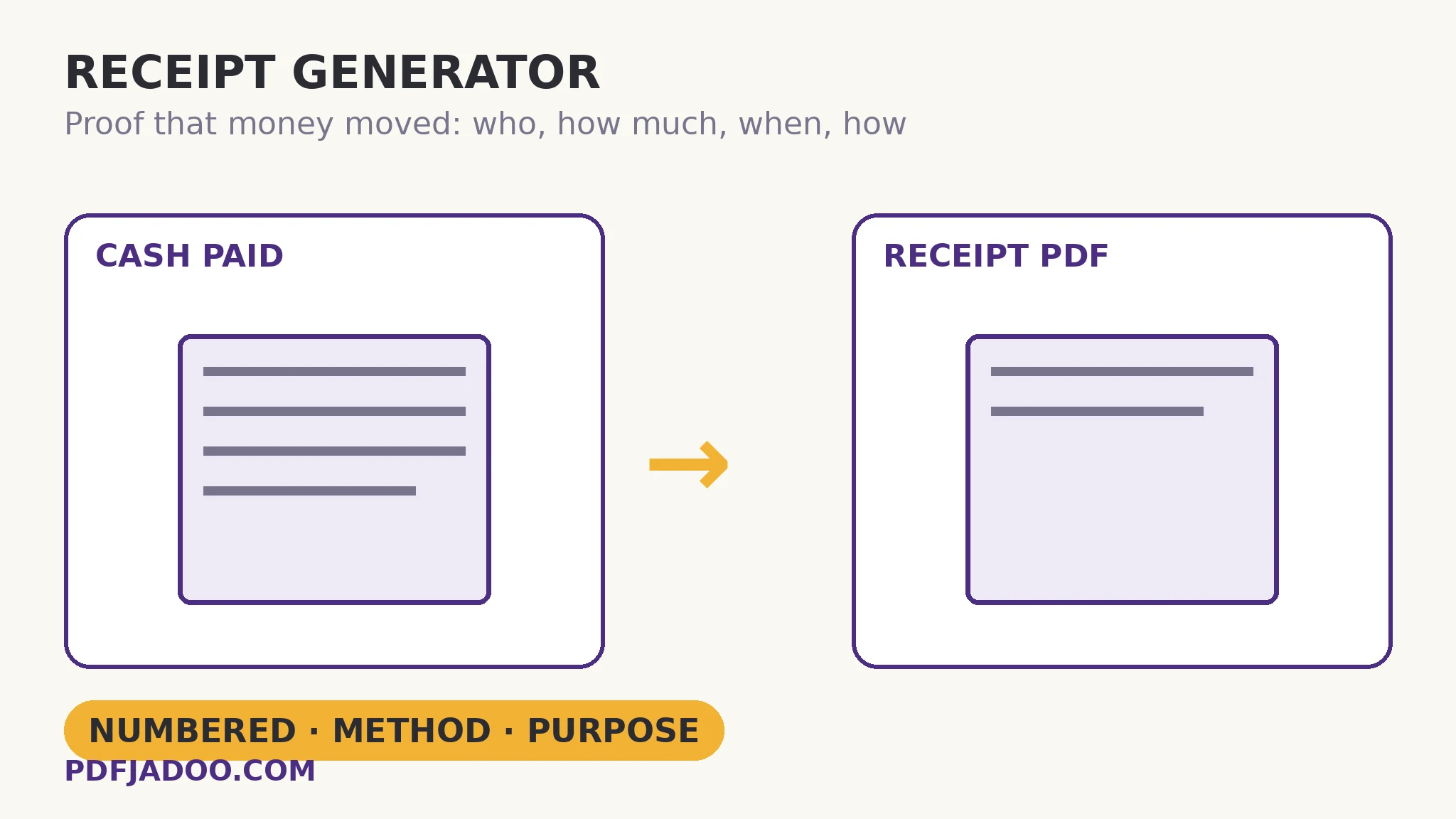
The direct answer: a receipt is proof of payment — it confirms money received, naming who paid, how much, by what method, for what, under its own receipt number and date — and it is issued when the money actually arrives, never when it is merely promised. Receipt Generator composes exactly that document: received-from payer, receipt number, date, amount, one of five currencies — $ Dollar, £ Pound, € Euro, Rs Rupees, AED Dirham — a payment method from Cash, Bank transfer, Card, Cheque, Mobile wallet or Other, a “For” line stating what the payment covers, notes, and templates with an optional logo. The page's good-practice tip is the chain's connective tissue: reference the invoice number in the “For” line, so the receipt visibly settles that invoice. Two honest mechanics complete the picture: the amount prints in clear figures — an amount in words is not added automatically, so write it in the Notes if your practice requires it — and part-payments are receipted as part-payments: write “part payment toward INV-001” in the For line, and receipt the balance when it lands. This article is the receipt's discipline: timing, fields, and the wording that keeps partial money honest.
 By the PDFJadoo Team5 min read
Timing is the receipt's whole ethics
The direct answer: issue the receipt at receipt — when the transfer lands, the cash is counted, the cheque is in hand — because a receipt issued early is a false statement about money, and one issued late leaves the payer unprotected in the gap. The distinction from its siblings is categorical: the invoice asks (before payment), the receipt confirms (at payment), and swapping their order corrupts both documents' meaning. A client who has paid and holds no receipt owns a bank statement and an anxiety; the professional habit — receipt issued the same day, unprompted — is remembered long after the work is forgotten.
The fields each earn their place. The payment method matters because methods fail differently: a cheque can bounce (receipt the cheque's receipt, and let the bank confirm the clearing), cash leaves no other trail (the receipt IS the trail), a transfer carries its own reference (mirror it in the notes). The receipt number continues your own sequence, so a payer quoting “receipt 118” reaches one document in your file — the same numbering discipline as invoices, applied to confirmations.
Part-payments: the wording that keeps balances honest
The direct answer: receipt exactly what arrived, and say so — “part payment toward INV-001” in the For line — so the document proves a partial settlement and the outstanding balance stays unambiguous on both sides. The failure mode it prevents is the oldest in small business: a round-sum receipt for a part-payment, later remembered by one side as settlement in full. Words in the For line, written at the time, are the entire cure — and the balance, when it lands, gets its own receipt referencing the same invoice, closing the chain link by link.
Make a receipt, step by step
The direct answer: enter the payer, receipt number and date, the amount and currency, the payment method, and a For line that references the invoice — then check the preview and download.
Step 1 — confirm the money first. Transfer visible, cash counted, cheque in hand. The receipt follows the money, never precedes it.
Step 2 — fill the parties and the number. Received-from (the payer), the next receipt number in your sequence, today's date.
Step 3 — amount, currency, method. The exact amount received — part-payments receipted as the part, not the whole — the currency from the five, and the method from the six offered.
Step 4 — the For line. What the payment covers, with the invoice number referenced: “Part payment toward INV-001” or “Payment in full — INV-001”. Add an amount in words in the Notes if your practice requires one; it is not added automatically.
Step 5 — template, preview, download, send. The live preview is the document. Send it the same day; file your copy by its number.
The chain, closed
The direct answer: quotation promised, invoice asked, purchase order committed, receipt confirmed — four documents, one set of numbers, matchable at a glance by anyone auditing the job later. The receipt is the link that turns the chain from paperwork into proof.
Money arrived. Say so, in a numbered document, today.
Payer, amount, method and the invoice it settles — the confirmation your client keeps and your file needs.
Open Receipt GeneratorA worked example: the deposit and the balance
The direct answer: a 40% deposit on an accepted quotation is receipted on arrival with “part payment toward” wording and the invoice reference; the balance, six weeks later, is receipted on its own number against the same reference — and the client's file and the tradesperson's file tell the identical story without a single email. The walkthrough's point is the gap the documents bridged: between deposit and balance, the client changed bookkeepers. The new bookkeeper's first question — what has been paid on this job? — was answered by two numbered receipts, not by anyone's memory. That is what the chain is for: it survives staff changes, drawer changes and time.
Edge cases
The cheque that later bounces. The receipt recorded a cheque received; the clearing is the bank's event. Note the reversal against the receipt number in your records and re-open the balance — the receipt stays honest because it said “Cheque”, a method whose finality is conditional.
Cash without a receipt request. Issue it anyway. Cash leaves no other trail; the receipt protects the payer, and offering it unprompted is the trust signal.
Refunds. A refund gets its own record referencing the receipt it reverses — never delete or alter the original receipt; the sequence must show money in and money back as two events.
Before you finish: the 60-second check
- Money confirmed received before the receipt was issued — never before
- For line references the invoice number; part-payments worded as part-payments
- Payment method recorded accurately (cheques noted as conditional)
- Amount in words added in Notes where practice requires it — it is not automatic
- Receipt sent the same day and filed under its number
Fair questions
When should a receipt be issued?
When the money actually arrives — the transfer visible, the cash counted, the cheque in hand. A receipt confirms payment; issued early it is a false statement, issued late it leaves the payer unprotected in the gap.
What should the For line say?
What the payment covers, with the invoice number referenced — the good-practice rule that lets the receipt visibly settle that invoice. For a part-payment, write “part payment toward INV-001” so the balance stays unambiguous.
Does the receipt write the amount in words?
No — the amount is shown in clear figures; an amount in words is not added automatically. If your practice requires one, write it in the Notes field.
Which payment methods and currencies are offered?
Methods: Cash, Bank transfer, Card, Cheque, Mobile wallet or Other. Currencies: $ Dollar, £ Pound, € Euro, Rs Rupees and AED Dirham.
What is the difference between a receipt and an invoice?
The invoice asks for payment — itemised, numbered, with a due date. The receipt confirms payment arrived. Issue the invoice when the work is billed and the receipt when the money lands, quoting the invoice number on the receipt.
How do I receipt a part-payment?
Receipt exactly what arrived, worded as a part payment toward the invoice in the For line. When the balance lands, receipt it separately against the same invoice reference — the chain closes link by link.
Tool behaviour — the field set (payer, receipt number, date, amount, five currencies, six payment methods, For line, notes, templates with optional logo), the invoice-reference tip, figures-only amounts, and the part-payment wording — is from PDFJadoo's own Receipt Generator page. Checked 18 November 2026.
Keep reading
How invoice totals are calculated
The document this receipt settles: numbered, itemised, counted live.
A quotation clients can accept
The chain's opening promise, validity-dated and itemised.
The purchase order
The commitment document the supplier's invoice and your receipt mirror.
A document checklist you can tick off
Filing the chain: the checklist that keeps records findable.