The proposal: an argument — with the scope fenced in lines
The direct answer: a proposal persuades where a quotation only prices — it carries an overview, an optional why-choose-us, a scope of work written one deliverable per line, a timeline, a single Total investment figure, and terms ending in one clear next step, under a proposal number with a valid-until date. Proposal Generator takes exactly that anatomy: a proposal title, prepared by (with a contact line shown under it) and prepared for, the date, proposal number and valid until, templates with an optional logo, and the sections — Overview, Why choose us, Scope of work, Timeline, Total investment, Terms / next step — composed in a live preview that is the document you send. The page's own tip sets the tone: keep the overview about the client, not yourself — their problem, their outcome, your understanding of both. And the division of labour is stated on the tool itself: a quotation prices a defined job while a proposal persuades on approach plus price — attach an itemised Quotation for the price detail, and let the proposal carry the single investment figure. This article is the structure's craft: scope as protection, timelines built backwards, and the single acceptance step.
 By the PDFJadoo Team6 min read
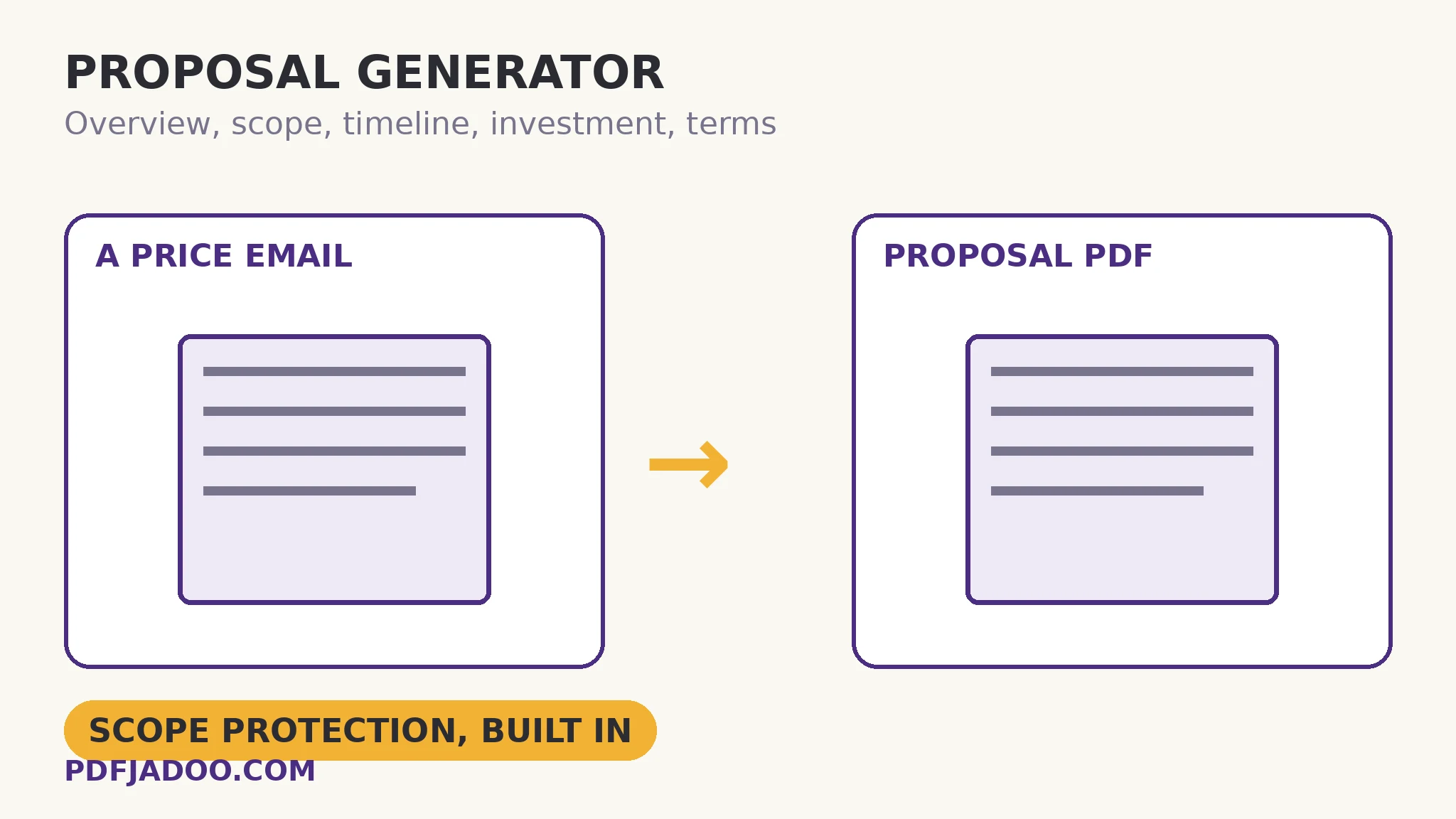
Scope: one deliverable per line is a protection system
The direct answer: writing the scope as discrete lines — one deliverable per line — converts the proposal's promise into a checklist both sides can audit, and what is not on a line is visibly not included, which is the entire defence against scope creep. The generator's scope field is built for exactly this granularity: each line a thing the client receives (a deliverable, a session, a revision round), never a paragraph in which inclusions hide. One quotable pairing completes the fence: the Terms field carries the explicit exclusions and assumptions — what the investment does not cover, what the client supplies, what happens on changes — so the proposal's yes attaches to a bounded offer, not an open one. Scope disputes are lost in the writing, months before they are argued; lines and terms are where they are won.
The single Total investment figure does the persuasion's arithmetic: one figure, because a proposal is an argument for a decision, and decisions are made on single numbers — the itemised proof lives in the attached quotation, where rows belong. Two documents, two cognitive jobs: the proposal makes the client want the outcome; the quotation makes the number checkable.
The timeline, built backwards
The direct answer: draft the timeline from the delivery date backwards, and build the client's own review windows into it — the schedule that survives contact with reality is the one that already contains the waiting. Milestones read as commitments with dates; dependencies (client supplies the brand assets by week two) belong in the timeline or the terms, named while they are still cheap to name. A proposal whose timeline assumes instant client responses has scheduled its own delay.
Build a proposal, step by step
The direct answer: set title, parties, number and validity; write the overview about the client; list scope one deliverable per line; lay the timeline backwards from delivery; state the single investment; close with terms and one next step.
Step 1 — header facts. Proposal title; prepared by (your contact line prints under it) and prepared for; date, proposal number, valid until — the same validity discipline as a quotation.
Step 2 — the overview, about them. Their problem, their outcome, your understanding — per the tool's own tip. Why choose us follows, optional and brief: proof, not biography.
Step 3 — scope, one deliverable per line. Every line a receivable thing. If it is not on a line, it is not in the offer.
Step 4 — timeline and investment. Milestones backwards from the delivery date, client review windows included. One Total investment figure — with the itemised quotation attached for the detail.
Step 5 — terms and the next step. Exclusions, assumptions, change handling in Terms; then a single clear acceptance step — reply to this proposal, sign, or pay the deposit — one door, clearly marked. Preview, download, send.
Validity and the follow-up
The direct answer: the valid-until date applies the quotation's discipline to persuasion — capacity and prices are offered with expiry — and a proposal nearing its date earns one polite follow-up naming the date, which is information, not pressure. Lapsed proposals re-issue under a new number at current terms, like lapsed quotes.
Win the argument. Fence the scope. One figure, one next step.
Overview about the client, scope a line at a time, timeline built backwards — composed live, sent as one document.
Open Proposal GeneratorA worked example: the agency's website proposal
The direct answer: a small agency's proposal for a clinic's website — overview written around the clinic's booking problem, scope in nine deliverable lines (discovery, sitemap, design, build, content migration, training, launch, two revision rounds, handover), a six-week timeline with two client review windows drawn in, one investment figure, and the itemised quotation attached — wins against two cheaper paragraph-proposals. The walkthrough's evidence is the client's own debrief: they could see what they were buying, line by line, and could see the schedule already respected their review time. Mid-project, a requested extra (a second language) was priced as a variation against the scope lines without friction — the fence made the addition a transaction instead of an argument. The proposal's structure was still working months after it won.
Edge cases
The RFP with its own format. Where a buyer mandates a structure, follow theirs in the sections and keep this one's disciplines inside it — scope lines, terms, one figure, validity — under their headings.
Very small jobs. A one-page proposal is a quotation with an overview paragraph; do not inflate a defined job into a persuasion document. Match the instrument to the decision's size.
Internal proposals. The same anatomy persuades inside a company — overview about the team's problem, scope lines, timeline, one figure — with the next step being the approval you actually need.
Before you finish: the 60-second check
- Overview written about the client — their problem and outcome, not your biography
- Scope written one deliverable per line; exclusions and assumptions in the Terms
- Timeline built backwards from delivery, with client review windows included
- One Total investment figure in the proposal; itemised detail in the attached quotation
- Valid-until date set; one clear acceptance step closes the document
Fair questions
What sections does a proposal need?
Title; prepared by and prepared for; date, proposal number and valid until; an Overview; an optional Why choose us; Scope of work one deliverable per line; a Timeline; a single Total investment figure; and Terms ending in one clear next step.
What is the difference between a proposal and a quotation?
A quotation prices a defined job — itemised rows, totals, validity. A proposal persuades on approach plus price. Attach an itemised Quotation for the price detail and let the proposal carry the single investment figure.
Why write scope one deliverable per line?
Lines make the promise auditable: what is on a line is included, what is not is visibly not — the defence against scope creep. Paragraphs hide inclusions; lines expose them, which is the point.
How should the overview be written?
About the client, not yourself — their problem, their outcome, your understanding of both. That is the tool page's own tip, and it is the difference between a proposal that is read and one that is skimmed.
Why one investment figure instead of itemised prices?
A proposal is an argument for a decision, and decisions are made on single numbers. The itemised proof belongs in the attached quotation, where rows are checkable — two documents, two jobs.
Does a proposal need a valid-until date?
Yes — capacity and prices are offered with expiry, as on a quotation. A lapsed proposal re-issues under a new number at current terms.
Tool behaviour — the field and section set (title, prepared by/for with contact line, date, proposal number, valid until, templates with optional logo, Overview, Why choose us, Scope of work, Timeline, Total investment, Terms/next step), the live preview, the overview tip, and the proposal-versus-quotation division — is from PDFJadoo's own Proposal Generator page. Checked 18 November 2026.
Keep reading
A quotation clients can accept
The figures companion: itemised, totalled, validity-dated.
How invoice totals are calculated
Where the won proposal ends up: billed, line by line.
The purchase order
The client's acceptance, formalised in their own numbering.
An ATS-friendly CV from a builder
Another structured persuasion document — for a career instead of a contract.